
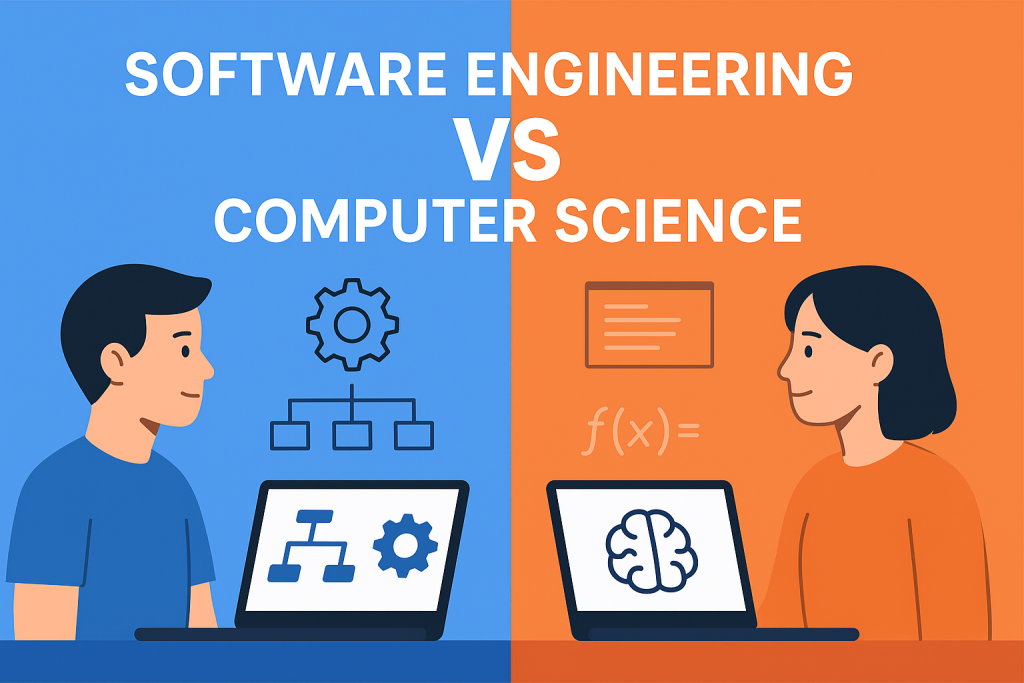
Technology has become part of almost every job, industry, and business today. Because of that, more students than ever are choosing careers in tech. Two of the most popular study options are Software Engineering degrees and Computer Science degrees. At first glance, they look very similar. Both involve programming, both can lead to software jobs, and both sound like they cover the same subjects. But in reality, they are not the same.
This article breaks down the similarities, differences, and career opportunities for each. By the end, you should have a clear idea of which path matches your goals.
What Is Computer Science?
A Computer Science (CS) degree focuses on the theory and principles behind computing. It is less about writing code to build apps, and more about understanding how computers actually work at a deeper level.
Computer Science answers questions like:
- How can we make an algorithm run faster?
- How do computers process language, images, or sound?
- What makes an operating system secure and efficient?
Key Subjects in Computer Science
A typical CS degree includes:
- Algorithms and Data Structures – the building blocks of problem-solving.
- Programming Languages – not just how to code, but how languages are designed.
- Operating Systems – how software communicates with hardware.
- Artificial Intelligence (AI) – creating systems that learn and adapt.
- Cybersecurity – keeping systems and networks safe.
- Database Systems – storing and managing large amounts of data.
- Computer Graphics – rendering visuals, used in gaming and simulations.
Skills You Gain in Computer Science
- Strong background in mathematics and logic.
- Ability to design new algorithms.
- Problem-solving at abstract levels.
- Research skills for exploring new technologies.
Career Paths in Computer Science
With CS, you can enter:
- AI and Machine Learning
- Data Science
- Cybersecurity
- Systems Architecture
- Academia or Research
These jobs often push the limits of what technology can do.
What Is Software Engineering?
Software Engineering (SE) is focused on the practical process of building reliable and usable software. Where CS studies why a system works, SE is about how to build it step by step.
It takes concepts from Computer Science and combines them with engineering methods like testing, project management, and design frameworks.
Key Subjects in Software Engineering
An SE degree usually covers:
- Software Development Life Cycle (SDLC) – from planning to deployment.
- Agile and DevOps Practices – modern ways of managing development teams.
- Software Testing and Quality Assurance – ensuring products work correctly.
- Requirements Engineering – understanding what clients or users need.
- Software Architecture and Design – structuring large applications.
- Human-Computer Interaction – making apps user-friendly.
Skills You Gain in Software Engineering
- Strong coding ability in modern languages.
- Experience with project workflows like Agile and Scrum.
- Testing and debugging methods.
- Communication and teamwork in building large projects.
Career Paths in Software Engineering
SE graduates often work as:
- Software Engineers
- Web or Mobile Developers
- DevOps Engineers
- QA Engineers
- Product Managers
- Systems Engineers
These roles focus on delivering products and solutions that people or companies actually use.
Similarities Between Software Engineering and Computer Science
It’s easy to confuse the two because they share many things:
- Both require programming skills.
- Both involve problem-solving and logical thinking.
- Both open the door to software development careers.
- Both are in high demand worldwide.
In fact, many CS graduates work in software engineering roles, and many SE graduates end up exploring areas of computer science. The overlap is large, but the core focus is where the distinction lies.
Key Differences: SE vs CS
Here’s a direct comparison:
| Aspect | Computer Science | Software Engineering |
|---|---|---|
| Main Focus | Theory, algorithms, computing fundamentals | Designing, building, and maintaining software |
| Skills | Math-heavy, research, algorithm design | Coding, teamwork, project management |
| Approach | Abstract and research-driven | Practical and application-driven |
| Subjects | AI, cybersecurity, theory of languages | Software testing, DevOps, project workflows |
| Best Fit For | Students who love theory and exploration | Students who want to build working products |
| Careers | AI engineer, data scientist, researcher | Software engineer, QA, product manager |
Which Degree Should You Choose?
This depends on your interests and strengths.
Choose Computer Science If:
- You enjoy mathematics and abstract problem-solving.
- You’re interested in fields like AI, data science, cybersecurity, or systems design.
- You might want to pursue a master’s or PhD.
- You see yourself working in research or cutting-edge tech.
Choose Software Engineering If:
- You like building real-world applications.
- You enjoy teamwork and project-based work.
- You want to focus on app development, DevOps, or software product delivery.
- You’re less interested in abstract math, and more in applied results.
The Job Market
Both degrees have excellent job prospects. The tech industry is growing, and companies need both theoretical thinkers and practical builders.
- Computer Science roles: Growing fastest in AI, data science, and cybersecurity. For example, AI engineers are expected to see job growth above 20% in the next decade.
- Software Engineering roles: Still the backbone of the tech industry. Every business that builds apps, websites, or platforms needs software engineers. Demand is projected to grow steadily.
Salary-wise, both can lead to high-paying roles. Computer Science jobs in AI or data science often rank at the top, but Software Engineering roles in big companies also pay extremely well.
Real-World Example
Imagine a company building a self-driving car:
- Computer Science graduates would work on the algorithms, like how the AI processes images from cameras, or how it plans safe routes.
- Software Engineering graduates would focus on building the software system, ensuring all components—from sensors to apps—work together smoothly.
Both roles are critical. Without CS, the AI wouldn’t exist. Without SE, the car’s system wouldn’t run reliably.
Frequently Asked Questions (FAQ)
Is Software Engineering harder than Computer Science?
Not necessarily. SE has more team projects and practical work, while CS has more theory and math. The difficulty depends on your strengths.
Can I get a software engineering job with a computer science degree?
Yes. Many CS graduates become software engineers because of the overlap in skills.
Which pays more: CS or SE?
It depends on the role. AI engineers and data scientists (CS-related) often have higher salaries, but senior software engineers also earn very competitive pay.
Do both require coding?
Yes. Both involve coding. CS may also involve more low-level coding (like C, assembly, or algorithms), while SE focuses on building applications with modern frameworks.
Can I switch fields later?
Yes. Many professionals start in one area and move to the other. The skills overlap enough to allow career flexibility.
Final Thoughts
Both Computer Science and Software Engineering degrees lead to exciting opportunities in tech. The difference is about focus: CS is about understanding computing at its core, while SE is about using that knowledge to build products.
If you’re drawn to research, theory, and AI, Computer Science may be right for you. If you’re more interested in developing apps, managing projects, and working in teams, Software Engineering might be the better choice.
Either way, you’ll be entering a field with high demand, strong salaries, and endless opportunities to grow.